ExaVerif
Exhaustive Verification for RISC‑V Custom Instructions
ExaVerif performs exhaustive verification of RISC‑V custom instruction extensions. A YAML file describing a module’s constraints is all that is required — ExaVerif generates every valid constraint combination, evaluates each one deterministically, and produces an auditable report with optional LLM‑powered interpretation. It is distributed under an open‑core model: the CLI is free and open‑source, while advanced interpretation, collaboration, and formal certification are available through paid tiers.
The Problem
RISC‑V’s defining advantage is its extensibility. Custom instruction extensions (XIF) enable domain‑specific acceleration for AI inference, signal processing, cryptography, and embedded control. Every custom instruction must be verified across its full operational envelope — operand ranges, pipeline states, data alignment, hazard conditions, and physical constraints.
The current verification tooling faces two persistent obstacles:
- No automated constraint composition. Random instruction generators produce statistical coverage but cannot enumerate the complete space of interacting constraints. When operand ranges, pipeline depth, and alignment rules combine, the number of valid configurations reaches into the thousands. Manual test writing cannot scale to cover this space exhaustively.
- Non‑deterministic coverage. Random‑seed‑based simulation cannot determinically prove that a specific edge case was tested. Reproducing a failure requires preserving the exact seed, environment state, and tool versions — a fragile chain that breaks across teams and over time.
What ExaVerif Does
ExaVerif replaces random sampling with deterministic constraint composition. A developer describes the module’s constraints in a YAML file. A single command generates every valid constraint combination, evaluates each one, and produces a complete pass/fail report.
ev check --target my_xif.yaml
ev check --target my_xif.yaml --interpret
ev certify --target my_xif.yaml --output certificate.pdf
Internally, ExaVerif uses the Field Composition engine — a branchless, constant‑time verification kernel that has been internally validated via x86‑64 CI — to guarantee that every evaluation is deterministic. The same input always produces the same result, independent of random seeds or simulator state.
The optional --interpret flag runs a lightweight LLM pass over failures and explains why each one occurred. All results are committed as immutable Fact records to the shared blackboard — a verifiable, append‑only knowledge store shared across the RISC‑V verification ecosystem. Once committed, these facts become reusable verification knowledge for any project.
Why ExaVerif Is Different
| Existing Tools | ExaVerif | |
|---|---|---|
| Coverage | Random sampling, manual test writing | Exhaustive constraint combination |
| Evaluation | Seed‑dependent, simulator‑dependent | Deterministic |
| Setup | UVM/SystemVerilog environment, commercial simulators | Single YAML file, single binary |
| Interpretation | Manual log analysis | LLM‑powered natural‑language explanation |
| Result reuse | One‑time reports | All facts accumulated on shared blackboard |

Business Model
ExaVerif is distributed under an open‑core model. The CLI is open‑source (Apache 2.0) and free to use. Paid tiers provide advanced interpretation, collaboration features, and formal certification.
| Tier | Price | Scope |
|---|---|---|
| ExaVerif CLI | Free (Apache 2.0) | ExaVerif check — basic composition and evaluation |
| ExaVerif Pro | draft | --interpret LLM analysis, history, blackboard access |
| ExaVerif Enterprise | draft | Custom constraint templates, CI/CD integration, SLA |
| ExaVerif Certification | draft | Signed verification certificate with on‑chain proof |
Certification pricing reflects the complexity of the module under verification — a single‑cycle integer XIF with two operands sits at the lower bound; a multi‑cycle vector accelerator with pipeline interactions and physical constraints sits at the upper bound. Each engagement produces a cryptographically signed audit report and, optionally, an on‑chain proof of verification.
Market Context
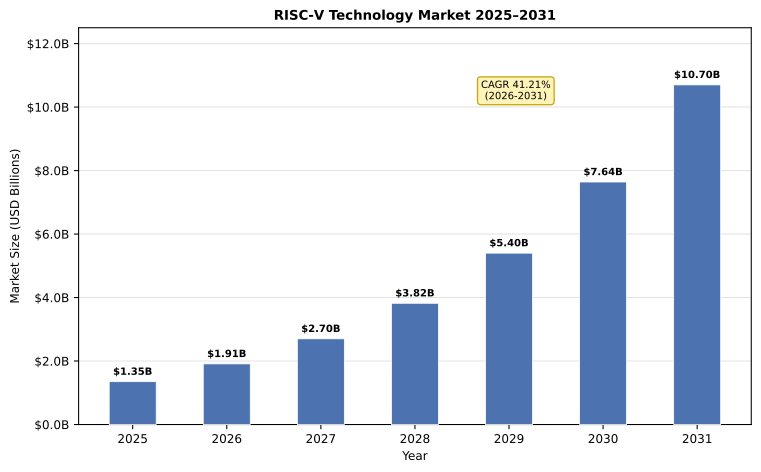
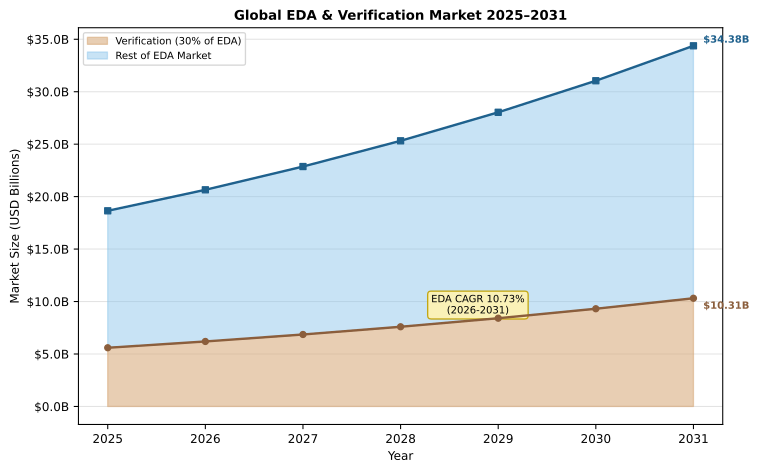
The RISC‑V technology market is projected to grow from $1.35B in 2025 to $10.7B by 2031 at a 41.2% CAGR. Verification accounts for roughly 30% of the broader EDA market, which reached $19.22B in 2025. Custom instruction extensions are a primary driver of RISC‑V adoption, and every custom instruction requires verification that existing tools cannot exhaustively provide.
Competitive Landscape
| Tool | Approach | Limitation |
|---|---|---|
| RISCV‑DV | Constrained‑random instruction generation | Statistical coverage; misses deterministic edge cases |
| Breker SystemVIP | AI‑assisted test synthesis | Random seed‑based; commercial license required |
| ImperasDV | Simulation‑based verification with RVVI | Requires commercial simulator; manual test writing |
| VC Formal / Axiomise | Formal property verification | Complex setup; verifies specific properties only |
| RiESCUE | Directed compliance testing | Limited to specific extensions; no combination generation |
No existing tool performs exhaustive constraint composition. ExaVerif addresses this gap by generating every valid constraint combination and evaluating each deterministically.
Collaboration with the Ecosystem
ExaVerif is being developed as an independent product within the RISC‑V ecosystem. It is not tied to any single organization, core, or workflow. The project welcomes collaboration with groups working on RISC‑V verification — including OpenHW, PULP, and individual core developers — to validate the approach against real‑world custom instruction extensions and to integrate ExaVerif’s deterministic constraint composition into existing verification workflows.
Collaboration is structured as a mutual exchange: partners provide domain expertise and access to real‑world XIF designs for validation; the ExaVerif project provides the tool, methodology, and certification infrastructure. All verification facts generated through collaboration are deposited on the shared blackboard, where they become reusable knowledge for the entire ecosystem.
Connection to the Substrate
ExaVerif is an independent domain entity built on the shared substrate — a working demonstration of the model described in the Project Model. Every verification run feeds the shared blackboard. A failure pattern discovered in one module becomes a hint for every other RISC‑V project. The product earns revenue; the substrate earns knowledge.